It’s been a while since I’ve posted on here, which is usually the indicator that things have gotten busy behind the scenes! And they have.
In my not-so-new role at HDRC I am now supporting three funding applications, working with two community groups and exploring different career progression options. It’s busy, but I’m also really enjoying it 🙂
So, are you sitting comfortably? Then I’ll begin…
A few weeks ago I was sent a review copy of Jane Hearst’s Book A Creative Health Communication Framework. As someone who has worked in creative spaces for a long time, I was interested to see how she would articulate the benefits of creative practice in a healthcare space. These two areas often clash and struggle to understand each other because the language and context is so different. Hearst’s book is really well thought out as it approaches the issue of communication between these two spheres by looking at it through the lens of market value and marketing. Whilst this sounds somewhat diminishing, the opposite is true: it provides the language to describe the value of this work in terms which can also be understood by commissioners and funders. Hearst’s research and engagement methodology is really sound and entirely appropriate to the people she’s working with, which adds even more credence to her work and the Framework itself is really practical without being reductive. (If you haven’t guessed, I’m recommending this book!)
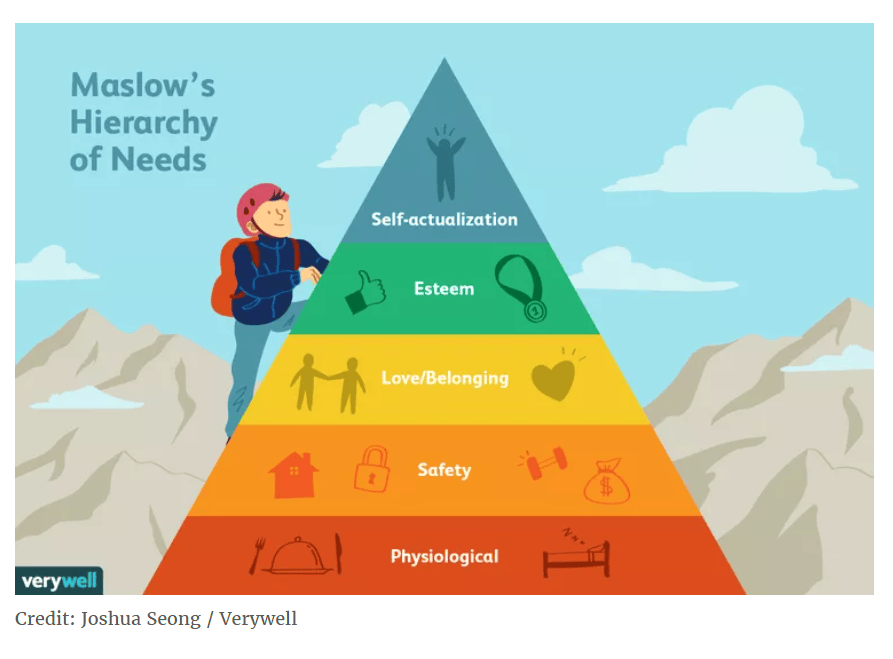
However, something I read in Hearst’s book absolutely threw me: she said that Maslow did not put his Hierarchy of Needs into a triangle.
Wait – what???
I had always believed that ‘Maslow’s Triangle’ just arrived somehow, fully formed, shiny and impenetrable.
Nope.
Hearst shared the link to the paper by Bridgman, Cummings and Ballard which explores the history behind how Maslow’s Hierarchy of Needs (HON) came to be known in it’s triangular form. They shared Maslow’s original paper, and how his theories were adopted in a post-war setting by management theorists. Davis in 1957 presented Maslow’s HON in a stepped-pyramid diagram in his book ‘Human Relations in Business’ , but it was McDermid in 1960 who first published a paper which showed the HON in the now familiar shape which came to be inseparable from Maslow’s original theory.
Nowadays there is plenty of discussion about challenges with the Triangle model: the fact that it implies movement in only direction, or that people can’t or won’t need to go down a level once they’ve passed it. It also reduces people to the sum of their needs, and doesn’t carry across global populations where some things such as housing or food security can look very different.
(I’ve been having some fabulous and brain-aching conversations with colleagues within and outside HDRC and I’m very grateful to all of them for their time and willingness to chew on this with me!*)
But let’s take a step back for a moment, and consider the context…how did we get from there to here? As explained in Bridgman et al, Maslow was an eminent Psychologist, not a Management theorist. They explain:
“In December 1941 Maslow had a revelation. Sitting in his car, watching a parade of veterans pass by, he reflected on the world going to war once again. At that moment, he resolved to devote his life to developing a “psychology for the peace table” (Hoffman, 1988: 148). Maslow wanted “a psychology that would speak to human potential and wholeness” (Ballard, 2006: 2). He saw biological needs as prepotent and needing to be satisfied, but once satisfied, higher level needs could emerge.”
After the war ended, many countries were on shaky legs financially (wars are expensive – who knew?) and they needed to get their economies moving again, in order to pay off war debts and rebuild. There was a rising demand for companies to grow, create jobs and feed the economy and it’s around this time that we also see the rise of Capitalism and related strategies such as Planned Obsolescence.
The post-war era saw an economic boom which I don’t think we’ve ever seen replicated since. Known as the Golden Age of Capitalism it took place between 1951-1971/3 and guidance on management and corporate strategies were in high demand. Bridgman et al believe it was this demand for training and guidance on ‘how to build a successful business’ that drew trainers to Maslow’s work, which talked about the different ‘stages’ that employees might go through to achieve their potential, and they began to explore this to see how this could be harnessed in a corporate context. McDermid’s book which presented Maslow’s HON in the now familiar triangle format, was titled ‘How Money Motivates Men’. I don’t think you can put it any clearer than that?!
The Gold Age of Capitalism ended when a series of events including the collapse of the Bretton Woods Monetary System and the 1973 oil crisis led to a global recession as the pattern of manufacturing and international trade crumpled. The New Public Management Model emerged in the mid-1970s, partly in response to this global instability.
*** ***
I’m going to pause the history lesson at this point, and direct you instead to a conversation I had with a very dear friend, Peter. He shared with me some of his experiences moving from his previous role into the current one. Knowing that he was leaving his old job, and that he was a qualified Life Coach, some people asked if might move into Life Coaching as the next step in his career.
Peter explained to me: “I thought about it, but in reality, the people who really need this kind of help, couldn’t afford it.” He went on to explain that Life Coaching sessions cost around £200 for 45 minutes. He reasoned that people who had access to those kind of resources, probably had access to other resources as well, but for people without the funds, it was simply unachievable.
We reflected that for people on lower incomes or accessing state help, the offer appears to be: “Well, we’ll help you sort out the basics, like food or accommodation, but after that, you’re on your own.” “It’s a bit like Maslow’s Triangle isn’t it?” I said. “We’ll help you out with the bottom two layers and after that, we don’t really care, or it’s not our responsibility.”
After our discussion, I took some time to try and map out everything we’d talked about as it felt important (and sometimes the best way for me to make sense of things is visually). What I created is the Health Inequalities mindmap below:
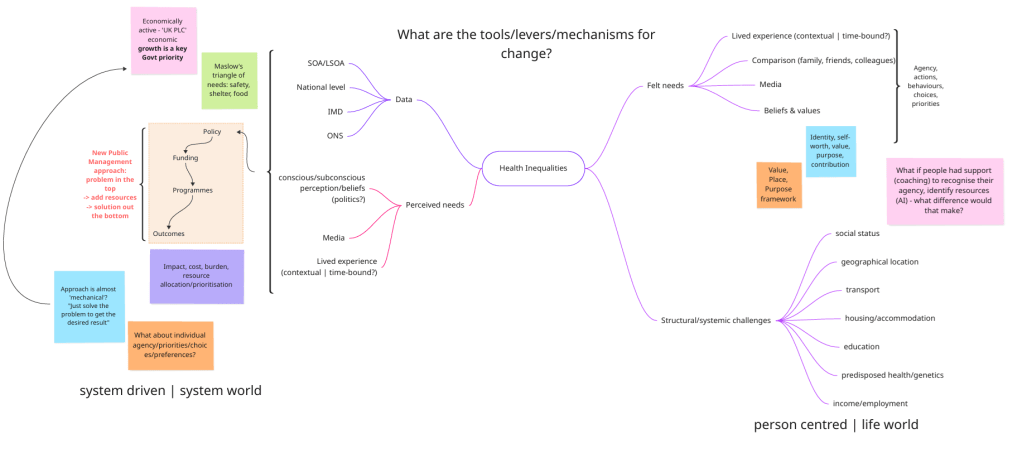
(Like Maslow, I will add a disclaimer to say that this is a work in progress!) I appreciate that the font will be very small (!) but the left hand side shows what shapes/informs decisions around Health Inequalities from a ‘system’ perspective. So here we have data (from various sources) as well as the ‘perceived needs’ of people living with health inequalities (that’s what we as staff, funders, service commissioners etc think that people need).
All of this goes into the ‘system’ to fix the problem. The beige/peach-coloured box shows how the mechanism works: the problem goes in the top; we add some resources, jiggle it all about a bit, and the solution comes out the bottom. The issue is that this approach deals with problems individually, not all at the same time, but in real life everything is always happening all at once, so this approach doesn’t really work.
Also, it doesn’t really allow any agency or choice for the individual. They don’t get to choose which problems are addressed, or in which order they get tackled. The person receiving the services can’t ask for ‘this’ and not ‘that’ and if they don’t engage, the system rejects them. They’ll also get rejected if their needs aren’t considered severe enough – or are too complex. The system also seems to prioritise meeting the basic needs (food, shelter, security – echoing Maslow’s HON), but the offer doesn’t extend beyond that.
The left-hand side, I realised, reflects our current way of working in public services, which is known as the New Public Management model. I won’t got into detail here, as I’ve written about this before.
The right hand-side shows things from the perspective of the individuals experiencing health inequalities. It shows their felt needs (what they feel is most important) rather than someone else’s opinion of what’s most important. It shows, not the data, but the factors at work which shape their life experience (housing, transport, income etc). It also links nicely with a model I created some years ago called Value, Place and Purpose (VPP).
Value is your unique and intrinsic worth as a human being. Place is who and where you are connected to: people, places, relationships, localities. Purpose is your contribution to wider society – or what would be missing if you weren’t there.
The right hand side asks: how would things change if people were offered life coaching or other kinds of support, which prioritised their felt needs instead of system-led perceived needs?
As my thoughts continued to unfold, and I wove VPP into my thinking, it occurred to me that the triangle version of Maslow’s HON (which he never invented – can I just mention that again?!) doesn’t work and doesn’t reflect the reality of everyday life. A ladder or scale…a hierarchy at all really doesn’t reflect the variety of circumstances of everyday life and how things change across the course of your life. We don’t need a ladder or a pyramid which sends us all on a quest to progress through different levels in order to conquer some mystical summit – besides, what happens when you get there?? Is that it?!
What we need is a flower.
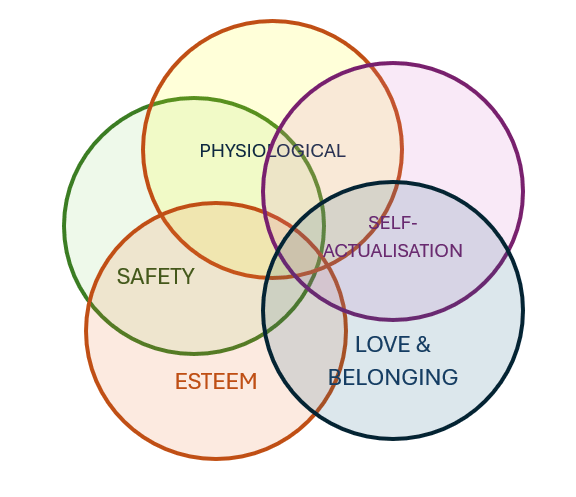
Here we have the same categories as shown in Maslow’s original work, but arranged as a series of overlapping circles. In this configuration, people can move easily between the different spheres, depending on their circumstances and what they need at the time. You could apply a star or radar diagram to it, to show how well people think they’re doing in each area and then re-plot it at a later date to show any progression or change.
I think this layout is much more flexible and shows the reality of how needs change during the course of someone’s life. It can also allow for people to choose an area(s) which they feel is more important at a particular moment in time or that they want to build on.
Now at this point, we need to go back to our history lesson. Having discussed this with various colleagues, it certainly looks like Maslow’s HON has been incorporated into the New Public Management model and in turn has had quiet a significant impact on how our services are shaped. However, I have yet to identify a clear link between the two – so that’s what I’m going to do next! Most people I have spoken to about public services (both staff and service users) would agree that the system is flawed. They will probably also say “But it’s the best we’ve got.”
But what if isn’t?
The models such Human Learning Systems, the Liberated Method, Social Pedagogy and others all have the same person/relationship-centred approach, but our existing system really struggles with that. Perhaps one way to support transition from one system to another, is to show why it doesn’t work – by exposing the flawed thinking at its’ foundations? If I can find evidence that Maslow’s HON was built into NPM, then by adjusting the HON into a matrix or flower shape, perhaps we can reshape public services too….?
What do you think?
*Thank you to Peter Leonard, Gail Mann, Leah Fullegar, Sue Oatley, Tia Barron, Val Horvath, Dave Raper & Gabriel Eichsteller for your time and enthusiasm in engaging with me while I work this all out! 😀




Leave a Reply