I had a really interesting conversation recently, with researcher Alice Clarfelt. Alice is working on a Knowledge Transfer Partnership or KTP – this is a partnership between a university and external organisation to explore a particular topic and share learning on it.
We were talking about co-production in research and how complex it can be. Co-production can mean different things to different people, but my definition would be this:
The intentional choice to include people with lived experience in the design of an event, intervention or service which could have an impact on them and ensuring they have equal power on decisions made about this task/activity.
Examples of this could be: bus passengers helping to decide on bus routes; an autistic person being on a team organising an autism training event for professionals or young parents setting the topics for drop-in centres at a Family Hub.
Doing co-production well can be a challenge in itself and it does require a degree of self-awareness to notice when power structures or assumptions about who can make decisions, creep in and distort the power-dynamic. There’s also the need to acknowledge that people who are not used to working in ‘professional’ or office settings might not be familiar with the usual rhythm of project management and decision making, and so the way you’re used to working probably isn’t going to fit. Community or lived experience partners might need to think things through, understand how the process might work or how things might develop. In short, they’ll need more time.
There’s also a lot of learning that happens in-situ, or as you go along – this is things like how individuals like to work, what’s important to people and how they like to be supported. This is a more personalised approach and using something like a One Page Profile can help structure this kind of conversation.
This process requires time, trust and some brave and honest two-way conversations. I say two-way because it’s not just the people with lived experience who need to share this information, but the researcher as well. If someone is sharing personal information – and I don’t mean their date of birth or gender, but things like how they like to be supported or where they might need extra help, that creates vulnerability on their part.
If you’re asking someone to share something that matters, you should be willing to do it too.
For example: maybe someone with lived experience struggles with meeting first thing in the morning, because they have to take medication and it makes them feel nauseous for an hour or so. Instead of expecting them to tough it out, or assuming they can’t participate, simply move the meeting to later in the day.
That’s a fairly simple choice, but the extension work, if you like, is for the researcher to share something personal in a similar vein: “Oh, that must feel grim. I remember taking some antibiotics* once that made me feel really nauseous – it’s horrible isn’t it? They’re meant to make you feel better, not worse?!”
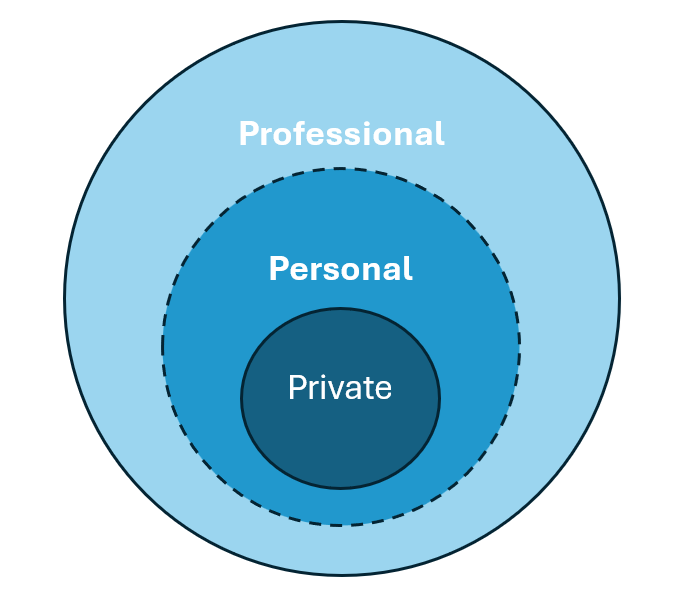
Sharing personal, but not private information in this way is something addressed through The 3 Ps. This is a concept in Social Pedagogy which talks about the healthy boundaries between your professional self, your personal self and your private self. Essentially, there are three concentric circles as you can see in the diagram.
The Professional outer layer is your job, what people see on your lanyard or what you’re responsible for. The central Private area is things that only your close family and trusted friends might know. But the Personal area is a slightly blurry, in-between space where you might choose to share things about yourself, but not something deeply personal or inappropriate – hence the dotted lines. This is the space where you might share things in order to build trust and empathy, so that the giving of information and vulnerability isn’t all one-sided.
So as a researcher, or co-convener in a co-production space, you’re being mindful of power dynamics, working to make sure the space is inclusive and accessible and trying to manage the boundaries between professional and personal, whilst also protecting your private space and simultaneously learning-designing-adapting-learning-adapting-resolving-designing-learning…..heartfelt, authentic co-production is messy, sometimes raw, sometimes wonderful and a whole range of things in-between! It is not for the faint-hearted or those who like to be in control and like everything clean, tidy and orderly!
Ok, so I’ve got that it’s messy – but that messy can be good. Where does the knitting come in?
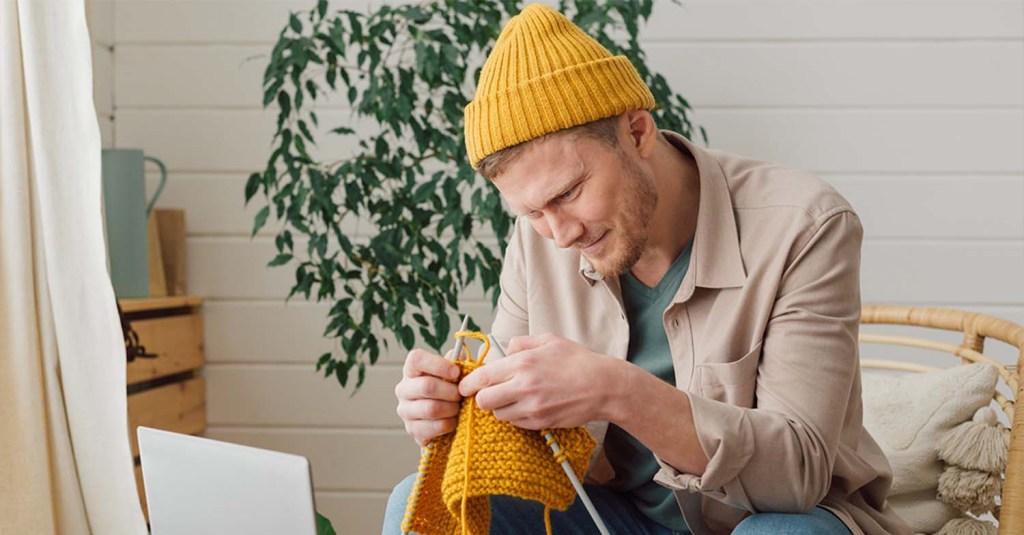
As I was talking to Alice, she was reflecting on how intense but also how rewarding co-production can be. “I feel like I’ve learnt so much, but I haven’t really had time to take it all out and look at it?!” Weaving together all the skills, learning and experiences of a co-production project reminds me of knitting: of finding ways to draw together all those different strands and make them into something coherent and recognisable. (Perhaps weaving would be a better analogy than knitting, but I’m invested now!)
The thing I find with knitting is that sometimes you’re so in-the-flow with the gentle repetition of stitches, that you don’t even notice how long your knitting has become**. It’s all pooled in your lap: row upon row of learning, experience, knowledge and skills, each building on the last, until you come up with something that has so much depth for each person involved…When you get to the evaluation, to say “Our project was a success” really doesn’t cover it. At all.
The challenge for those of us working in this space – both practitioners and community members, is to build in time to pause, reflect and consider what we’ve learnt. This can be developed through a learning cycle, ripple-effect mapping or other reflective tools. It can be discussion based, or use creative methods, but it’s helpful if someone external to the project is hosting this reflective space, so that everyone can engage equally. Without the built-in, intentional opportunities for reflection, we’re in danger of losing all the wonderful things, large and small, that we’ve learnt along the way.
That would be like your knitting all unravelling in a depressing, tangly heap…what a shame that would be!
*Disclaimer – not all antibiotics make people feel nauseous, but it can be a fairly common side-effect. That doesn’t mean you shouldn’t take them though – antibiotics will be prescribed thoughtfully and for good reasons.
**Maybe that’s just me? I’m not a skilfull knitter, but if it’s squares or rectangles you’re after, I’m your gal!


 Authentic PPIE - the (re)search for authentic engagement
Leave a comment