
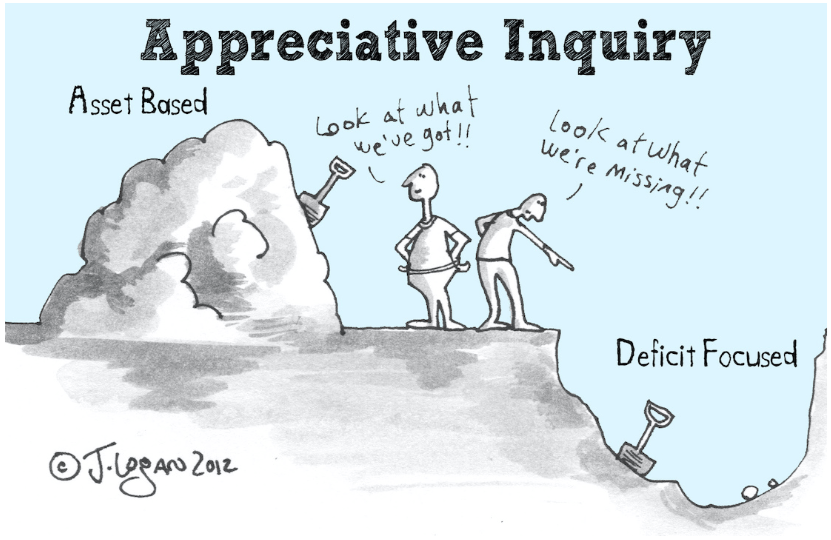
Image: (c) Jane Willis – taken from training slides
During September I had the opportunity to take part in a series of three training workshops on Creative Evaluation, led by Jane Willis. I was made aware of Jane’s work through one of the Patient Research Ambassadors at the hospital, and it was a cracking recommendation!
Jane Willis has been working in the field of creative health for many years, undertaking delivery and evaluation of a wide range of projects, as well as offering coaching and training. The training was really useful and engaging and has sparked a number of thoughts and reflections…
I can reconnect with my creative practice
For ten years, prior to joining the NHS, I worked as a freelance creative engagement practitioner. For those of you who are less familiar with this term, it basically means that I used all sorts of creative practice (traditional creative ‘stuff’ but also active listening, storytelling, play, music, spaces…) to help people engage with a particular theme. Rather than being a specialist in one skill like a sculptor or a painter, I used anything and everything to help create a space where people could engage with a conversation or a question. I didn’t think: “How can I use dance or ceramics to convey a message?” but instead: “What’s the story I want to tell and who are the people I’m telling it to? What do I need to achieve that?” People can feel intimidated by creative practice, a result largely I suspect of their experience in school. (If I had a penny for every time someone said “Oh, I’m not creative!” I would be a wealthy woman!) However, if you say to someone “There’s no pressure; we’re just going to play about with this stuff and have a conversation…oh, and there’s tea and cake over there, don’t forget to help yourself!” then the tone and focus of the activity is entirely different. There’s no pressure, no expectation to perform to certain standard. We’re ‘just playing and having a chat’. Some of the most beautiful, expressive, reflective pieces and conversations came out of spaces like that, and I loved it!
However, what I was lacking were the tools to really articulate what was happening in those spaces, for people who weren’t there. I didn’t have a way to accurately share the impact and benefit of creative approaches, which meant that people outside that space didn’t necessarily value it or understand the depth of conversation we were having.
But now I do. Jane’s training course has provided the scaffolding to go around my previous practice skillset, and I now feel much more confident that I could use creative methods as part of a research project or engagement activity. I can now see how Thematic Analysis can be used to draw out the value and depth of a creative session, and how having these kinds of tools helps to validate these approaches.
It’s useful in more than one place
The techniques and approaches we used and learnt about during the course, were much more than just academic practice. There were a lot of useful and practical reminders about how to ‘hold a space’ – that is, how to help people feel comfortable and able to engage. We talked a lot about psychological safety and how you can establish a space like that without just declaring ‘this is a safe space’. (I used to think that just saying that phrase aloud would somehow make it spark into being, which was very naïve. I have since learnt that being ‘safe’ means different things to different people. How you treat someone, and how your values are outworked in your every day life does a lot more to help someone feel ‘safe’ than writing it on a flipchart.)
What’s the question you’re trying to answer?
The sessions really helped me to refine and strengthen how I think about this. I know that asking the right question is important, but our discussions during the sessions helped me to further clarify that understanding. In a sense, for any project, you need to start at the end and work backwards: what is it you’re trying to understand? How will you know if you’ve got the information you need to answer that question? With that in mind, what shape does your project need to take, and what activities will you do, to create the conditions for that question to be answered? That’s the beginning of the project, and now you have a trajectory towards the end outputs. Also, we learnt about the importance of not trying to evaluate everything! Too much data doesn’t necessarily provide more clarity or understanding. Have a couple of clear questions and then you can use your intentionally collected data to answer those questions.
You’re not alone
The group was made of people from all kinds of backgrounds, which was absolutely fascinating! There were a couple of GPs, someone from the Liverpool Philharmonic Orchestra, someone else from the British Ceramics Biennial, someone evaluating a project being run by the University of Central London Archaeology dept, someone else working with people living with dementia and some freelance creative practitioners. What was fascinating were the things we had in common:
- evaluation feels overwhelming!
- how will I know I’ve got something useful at the end?
- I want this to be meaningful and not extractive or just a tick-box exercise
- how can I help the funders understand why this matters and the difference it makes?
- I don’t want to do yet another survey!
We had all fallen foul of the familiar traps of project evaluation: how many people turned up? How many of them stayed/remaining committed? How much money was spent? Did anything change? Using creative approaches allows for more nuanced and in-depth questions: how did people feel about being there? What felt important to them? What helped them keep coming along (if it was a course or programme)? How did they feel it impacted them? Instead of the ‘what’ questions (which are easy to measure) we had the tools to ask the ‘why’ and ‘how’ questions which are much more meaningful.
I need to make time to reflect – it’s where the learning happens
There’s a lot more about this course which is still marinating in my brain, but one thing which really struck me was the need to create and value space in my diary for me to reflect on what I’ve learnt. Without time to think through what I’ve been learning or absorbing, there’s no opportunity for it to become embedded and for me to retain what I’ve learnt. The (self-induced?) pressure to keep being ‘busy’ and keep up with emails etc can often mean that we don’t make time for learning and reflection after a training course. That’s like buying a really useful, precision tool and then as soon as you’ve unboxed it, you open the door to your ‘training cupboard’ throw it in and quickly slam the door shut, for fear of the avalanche of previous training courses falling out and pummelling you to the ground!! How is this learning useful if you’ve thrown it in your mental cupboard, never to be seen again?! Chances are, if you do dare to open the cupboard and find that specific tool, you won’t remember how to use it – and heaven knows where the instructions have gone?!
I’ll admit that I do trip up over this thing about ‘being busy’ and equating that with ‘being productive’ which is not the same thing. Sometimes I think I might be more productive if I gave myself permission to stop, or go for a walk, or get a coffee with a colleague and just talk through the things which have been burbling through my brain…after all, and overstuffed cupboard of ‘useful things’ is never going to be useful if you never open it?
So, in summary, I would highly recommend Jane’s course (there’s another one running in Jan 2026) and I found it valuable and useful in many more ways than just the ‘evaluation’ part. Even if you don’t think you’re a ‘creative person’, the tools on offer for engaging, meaningful evaluation would suit a wide range of settings and could be used by anyone, regardless of how experienced they might feel in this space.

 Authentic PPIE - the (re)search for authentic engagement
Leave a comment