
Image: https://www.hobbycraft.co.uk/wooden-letter-tiles-114-pieces/6219111000.html
Some months ago I was in a meeting with some PPIE (patient and public involvement and engagement) colleagues from across the region and someone mentioned: “Oh it’s PPIEP now, at least that’s what I heard.” I asked what the extra ‘P’ was for and they replied ‘participation’. I frowned and then, having thought about it for a bit asked: “But how can you have engagement or involvement without someone participating? Seems a bit superfluous to me?”. We shrugged and admitted we didn’t know and the conversation moved on.
The topic of the extra ‘P’ reappared this week when I was sent some documents relating to a new project being developed. The person who sent me the document explained that this is ‘the guidance for the additional PPIEP work’ and it took me a minute to realise what she was referring to.
And for a minute there I was cross. Irritated, but I didn’t quite know why?
As I sat at my desk and pondered I had a sudden revelation, and this post is the result. I wonder if this resonates with you too?
Let me take a step back for a minute…We have a bit of a hiccup between the NHS and Universities when it comes to ‘public involvement’ or ‘patient and public involvement’, because it’s only the NHS which differentiates between patients and the public (that accounts for the two ‘P’s at the beginning). In the context of the NHS, you might be a member of the public, but not necessarily a patient at that point in time. Or you could be a patient who is currently receiving treatment. The change in ‘identity’ between being a general member of the public and Mrs Jones who’s coming in for her regular check-up with the renal team can be quite stark. It reflects a difference in context and lived experience. For Universities, everyone is ‘the public’ and there’s no need to make a distinction. Either way, it seems that both P’s have stuck, whether it’s research within a healthcare or an academic setting.
Now this is where it gets interesting.
The next two letters are I and E. They represent Involvement and Engagement. These two words are not interchangeable but they do overlap somewhat. They mean subtly but importantly different things.
Engagement: The Oxford Learner’s Dictionary defines engagement (not the married sort!) as either ‘an arrangement to do something at a particular time’ or ‘being involved with somebody/something in an attempt to understand them/it’.
Involvement: Again the Oxford Learner’s Dictionary suggests: ‘the act of taking part in something or dealing with somebody’, ‘the act of giving a lot of time and attention to something you care about’
From my own experience in this field over the last 20 years or so, I would describe them as follows:
Engagement: an initial interaction in community outreach work. A conversation. Engaged consultation. A meeting in which external views are sought, but individuals contributing those views have no power over the outcome.
Involvement: The more active participation of people in a project or endeavour. The intentional choice of those with power, to share that power and decision making with others who may have valued insight or lived experience to contribute.
In short: those two letters indicate the degree to which power and decision-making is being shared with the people whose views are being sought. It’s a graduation, a transition from less power-sharing to more power-sharing.
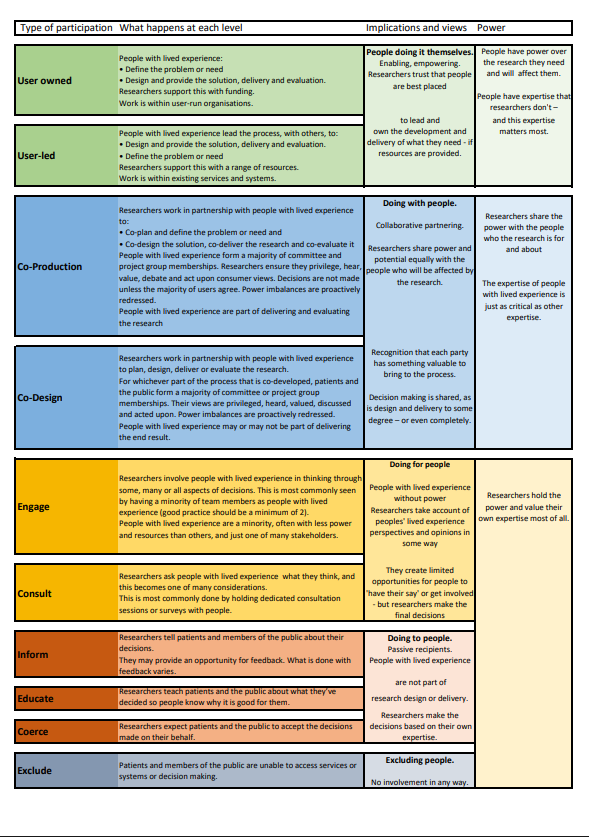
I came across this diagram by Barbara Molony-Oates after Indigo Daya recently on the Learning For Involvement website, hosted by the NIHR. It’s an expansion on the ‘engagement’ ladder and offers a more detailed explanation of the differences between involvement and engagement, in terms of power sharing. It’s far too small to read here, so I’d encourage you to view it on the original website (click on ‘diagram’ above).
The orange zone near the bottom includes terms such as ‘inform’, ‘consult’ and ‘engage’ but the summary column on the far right states: ‘Researchers hold the power and value their own expertise most of all.’*
Further up the diagram, towards the top of the page in the blue and green areas you’ll find terms such as ‘co-design’, co-production’ and ‘user-led’. The summary column states: ‘Researchers share the power with the people who the research is for and about’ and at the top of the table, it says:
‘People have power over the research they need and will affect them…People have expertise that researchers don’t – and this expertise matters most’
This.
This is the thing.
This is the thing which really matters to me and which PPIE should always aspire to be: the intentional involvement of non-professionals in research projects who have valuable expertise and insight, in order to positively impact the research which will ultimately affect them.
And this is why I struggle when people say: “Oh, I need to get PPI” or “I haven’t done PPI yet”. You don’t ‘get’ PPI, like you get a pint of milk…or ‘do’ PPI like you’re doing the laundry. PPI/PPIE shouldn’t really be a one-and-done task or conversation where you’re seeking affirmation for an idea which is already in development. PPI/PPIE should be, ideally, an on-going conversation and active participation of people who will be impacted by the research.
In some ways, even though the concept of PPI or PPIE has been around and developing over the last two decades, it feels like we’re still working out what it is and why it matters? We’re still figuring out how to do do it and difference it makes. I don’t think it’s down to a lack of information or resources…to be honest I’m not quite sure what it is? Maybe it’s a slow cultural shift within the culture of research, both in academia and healthcare, and maybe in years to come, my frustrations will be old news.
Oh, and as to that stray ‘P’ at the end; Oxford Learner’s Dictionary once more comes forward with a helpful explanation: ‘the act of taking part in an activity or event’. How, one might ask, can someone engage or be involved without ‘participating’? I think the extra ‘P’ has been added by a well-meaning someone who wanted to remind us that people ought to be taking part in things….
*I will add here that I’m not sure this is always a concious choice. In my meetings with researchers, particularly early career researchers, they appear to be more anxious not to get things wrong or ‘break the rules’. They seem unsure how and to what extent they can involve public contributors. More senior researchers might work in this way because it’s what they’re used to doing, or again because they assume they can’t involve public contributors in a power-sharing role without ethical approval. I suspect the reasons behind this are a bit more nuanced and depends on the individual and their personal beliefs.





 Authentic PPIE - the (re)search for authentic engagement
Leave a comment