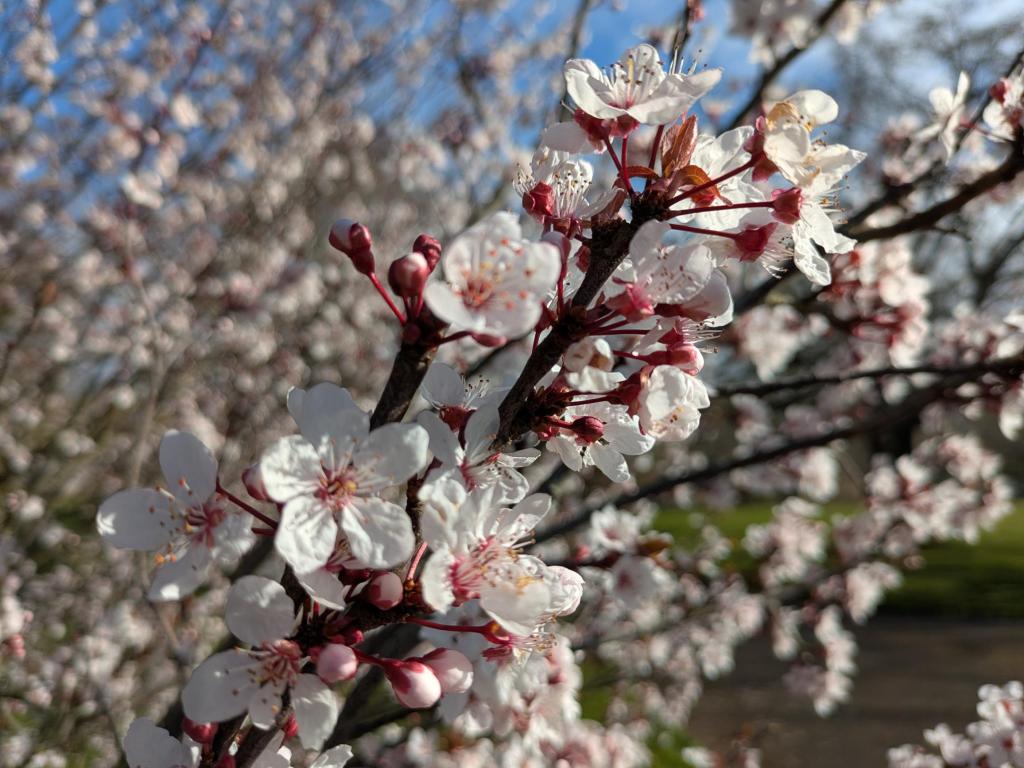
Image: Sharon Court
I live opposite a cemetery. We often walk our dogs there and it’s both peaceful and brimming with life, which probably seems like a bit of a contradiction given the setting? I can track the passing of the year by the plants and flowers which grow there, and it gives me an enormous sense of peace that, whatever is going on, whatever chaotic or concerning things are happening elsewhere in the world, the crocuses will still bloom.
They are preceeded by the hardy and determined snowdrops which sometimes emerge even before Christmas, depending on which variety they are. As the crocuses get into their stride, the daffodils will enter the stage, boldly proclaiming the hopeful arrival of Spring. And as the crocuses fall asleep, the woodland primroses make their more subtle entrance, with the vibrant British and Spanish bluebells not far behind. There’s something very reassuring for me about this constant rhythm of activity and rest; energy and peace – and curiously the world of research has many similarities.
My last blog post was in January and you’d be forgiven for thinking I’ve been hibernating, but actually there have been all sorts of things happening in the background…
At work I’ve been meeting new Patient Research Ambassadors (PRAs); updating our Governance documents and creating a new PRA Handbook; making new contacts in the Paulsgrove community and supporting one of our Sandbox community researchers to apply for a research internship through ARC Wessex, just like I did last year (SPOILER: she got it!)
I’ve also been trying to organise time to feedback on my research findings to the people who contributed to the project, either as a participant in the focus groups, or as part of the light-touch scoping review or the transcript analysis. I was finally able to hold two sessions on March 5th, in the same format as the PPI meetings: one meeting in the morning as a hybrid, and then again in the evening, but online only.
I will share what I learnt in a separate post, but I’m also planning to write up the project as a journal article and see if I can persude someone to publish it. In a second publishing effort, I have approach Bristol Policy Press (part of Bristol University) with an idea for a book! I sent over the first draft of the book proposal today and will wait to hear back from them in a few weeks.
I also decided to submit, not one but two abstracts to the Social Pedagogy Professional Association Conference which will be taking place in Gloucestershire in September. I’ve proposed sharing my research posters about the INSPIRE project (the premise and the findings) and also running a workshop looking at Social Pedagogy applied to PPIE work in healthcare research. The call for abstracts is open until May 2nd, so if you’re interested in contributing, you still have time!
I’ve also been having some fabulous conversations with colleagues across the UK about PPIE in research, and one quote in particular from the lovely Kirsty Rogers, really summed it up for me:
“I can be their voice, if it’s given to me.”
So much of the work in PPIE is about raising awareness of other people’s voices, and teaching researchers about the importance of relationship and permissioning. I can’t take someone’s voice or experience and interpret it or guess what it might mean, to suit my own research bias. But if I am trusted with someone’s voice, and I fully understand what matters to them – then I can share their voice with authenticity.
And that’s what research is really all about: getting people’s voices to the ears that need to hear them.




 Authentic PPIE - the (re)search for authentic engagement
Leave a comment