
Image: mindmap of my learning on the ARC Wessex Internship
Next week will be the end of my research internship.
The last six months have flown by and I still feel like I’m only just getting into my stride! There’s more I have to do, and more I want to do, but for now it seems like a good moment to take stock and look at what I’ve achieved and what might come next…?
As part of my internship I’ve been meeting regularly with two supervisors: Prof Mel Hughes from Bournemouth University and Prof Mari-Carmen Portillo from Southampton University, who is also the Theme Lead for Long-Term Conditions within ARC Wessex. Their role has been to help guide me through this process and offer advice and perspective as well as answering questions as I work my way through this project.
Naturally, any funding grant comes with an evaluation form, and one of the sections on the form asks: “What have you learnt?”. MC suggested making a note of what I’d learnt from my training courses while it was still fresh in my mind, and since then I’ve produced a mindmap (see image above) to try and capture to breadth of what I’ve discovered over the last six months or so.
Turns out it’s quite a lot!
I decided to try and break it down into:
- learning from the training courses (Social Pedagogy; person-centered research; collaboration; communication…)
- learning about the topic itself (PPI/PPIE and Social Pedagogy; PPI frameworks and approaches…)
- Technical research skills (ethics application; academic searches; writing a protocol, Consent form and Participant Information sheet…)
- Social & emotional learning (what have I learnt about myself? Learning styles; study skills; time management…)
- and Other Stuff: for example – it appears that using metaphor and analogy to explain complex contexts and relationship dynamics isn’t all that common?
Even though the mindmap looks very detailed, there’s a lot more I could add to the training courses section, which I shall probably do for my own benefit, otherwise I worry that it will slip to the back and I’ll forget it 😦 One of the things which really struck me during the courses I went to, was that there was still a lot for me to learn. I suppose some people might find that a bit discomforting or discouraging, but actually it has been a great catalyst to get stuck in to my research! I want to know and understand more about this issue which I’m passionate about, and it seems that there is more to learn! This is invigorating and it’s piqued my interest as I try and figure out PPIE and bring it more into focus.
I feel like I’m gradually bringing an array of puzzle pieces together, some of which fit fairly easily together, but others still need the connecting piece in between them to make them fit together smoothly. On top of that puzzle-sorting exercise is the sense that some of these pieces are also out of focus, and like a camera lens, they need a bit of tweaking to make the image sharp and clear.
At that point we might – in theory – not only have all the pieces (or at least enough to make sense) and be able to show how they connect to each other, but the sharper focus will also show why they connect in the way that they do.
One of the challenges about this work is the different perspectives which people have of the same thing. How a research study looks to a clinician is not the same as it looks to the public contributor who shared their personal experience in order to help shape the research in a way which made it more relevant and useful for the study participant who is now taking part in it, or the patient who might benefit from a new treatment as a result of the study. Those people are either contributing to the outcome of the study or benefitting from it – but they have all experienced the same project in a different way.
And that’s one of the crucial things about this area of work: holding, or making a space where that diversity of experiences are held equally and deemed to be equally valuable. That’s the role of the PPIE Lead (in this case me) and in truth, I too, am part of that group of contributors, with my own unique perspective of the project. A PPIE Lead stands between the worlds of the people* who enable research to happen and if at times those worlds clash, sometime a PPIE Lead’s role is to translate and negotiate so that the end results are the most useful they can be. This was one of the reasons why I decided to hold focus group meetings with 3 different groups of people with a connection to PPIE, so that I could try and find a way to capture and compare those different perspectives.
*The people involved in a research study may include and not be limited to: clinician, medic, public contributor, study participant, pharmacist, statistician, research nurse, clinical trials assistant, funder, research co-ordinator
The big question for my research internship has been: Is Social Pedagogy a good fit for PPIE in healthcare research?
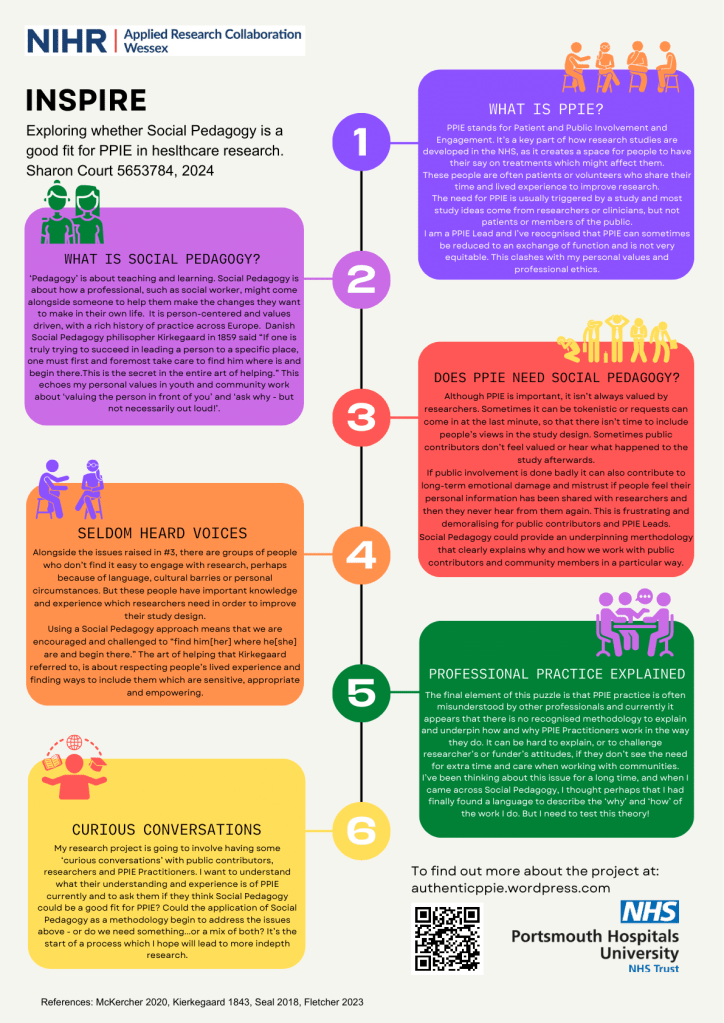
The reason for this question is that there is still a lack of understanding about what PPIE is, how it’s ‘supposed’ to work, what the purpose is and most importantly why and how we work in the way that we do.
I was searching for a unifying theorectical framework for PPIE – thinking that perhaps Social Pedagogy might serve that purpose – but in my first sweep of the literature I discovered that there are several!?
The more I read, the more I began to wonder whether we actually needed another ‘framework’ or model for how to do PPIE?
After all, we’ve got all the ingredients: PPI payments, role descriptions, PPI meetings and PPI Leads…we already have all the components, so why isn’t it working consistantly? Why is there such a disparity across the research community, about how public contributors are viewed and valued? Why don’t people understand that the talking is the work? It’s not just the components for PPIE that are needed, but an understanding of how and why they are needed, and how to use them together, in order to improve research.
And I guess that’s where my next steps will take me:
- a more thorough investigation of the literature so that I can bring those fuzzy puzzle pieces into focus**
- a pilot project to test whether the application of Social Pedagogy makes it easier to bring those puzzle pieces together?
- An evaluation*** to see what kind of impact this approach has, and whether it’s easy to repeat in other settings?
In the meantime, I’m going to review the transcripts of my focus group meetings and see what emerges from there. Hopefully my application for a Pre-application Support Grant will be successful and that will give me some time and support to apply for a Masters course, so that I can do some work on the points above.
I know that in some ways this looks like the end of a project, but honestly I feel like I’m just getting started!
** Try saying that five times very fast!
***I think that either a Realist Evaluation or Normalisation Process Theory approach might work well for an evaluation method…?





 Authentic PPIE - the (re)search for authentic engagement
Leave a comment