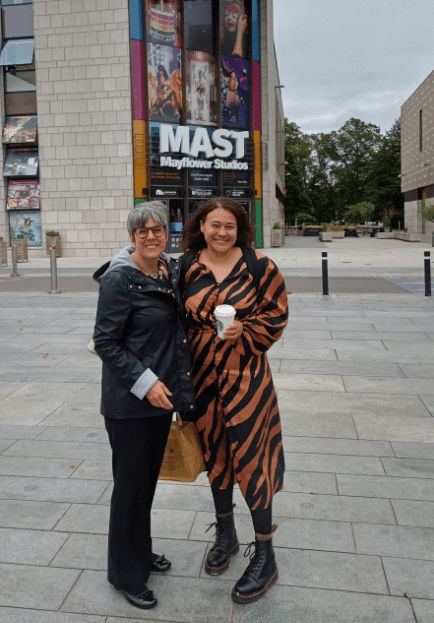
Image: Bianca and I outside the MAST Theatre, Southampton
Last week I travelled with my lovely colleague Gail from Portsmouth City Council, and the equally lovely Bianca from Mindset Maintenance, to the MAST Mayflower Studios in Southampton, to present about the Sandbox project, and separately about a Maternity project which I’ve also been supporting.
Both projects had been funded by the Clinical Research Network Wessex which is the regional team looking after research for the NIHR (National Institute for Health and Care Research). The NIHR is the research arm of the NHS.
CRN Wessex decided to launch a funding scheme a couple of years ago: Small Grants for Underserved Communities. Organisations from across the region were invited to apply for up to £10,000 to design and deliver a small project which would address an unmet need within underserved communities. An underserved community is any group of people which are not currently well represented in research studies and data. This can vary depending on the type of research being done, but it could be:
- people from ethnic communities
- people of working age (because they’re at work and can’t get time off)
- particular groups in particular disease areas e.g. you don’t get many men in breast cancer studies, but men can still get breast cancer
In research, we want to include as many different people as possible, because this means that the data we generate will be applicable to as many different people as possible. It’s no good saying that a certain medicine will work for anybody, if it’s only been tested on a few people. That’s like those shampoo commercials which say: “87% of people said this product was amazing!” and then you look in the bottom corner and it says: tested with a focus group of 13 people. I’m sorry, but that is not conclusive or reliable data!!
Scientific advancements in the study of our genes and DNA mean that we have a much better understanding of the tiny but significant differences people may have on a biological level, which can affect whether or not they will be more or less affected by a certain disease. If research is going to continue to improve and be of wider benefit, we need to find ways to include as many people as possible, so that the results can be applied to a diverse range of people. The CRN Small Grants programme was designed to do precisely that: support projects which intentionally set out to find ways to work collaboratively with people who aren’t normally included in research, and create projects which are tailored to meet their particular needs.
The Sandbox project was about supporting community-led research, where community members set the priorities or themes for the research, and community members then carry it out. There’s lots more to say about this, which I’ll cover in another post!
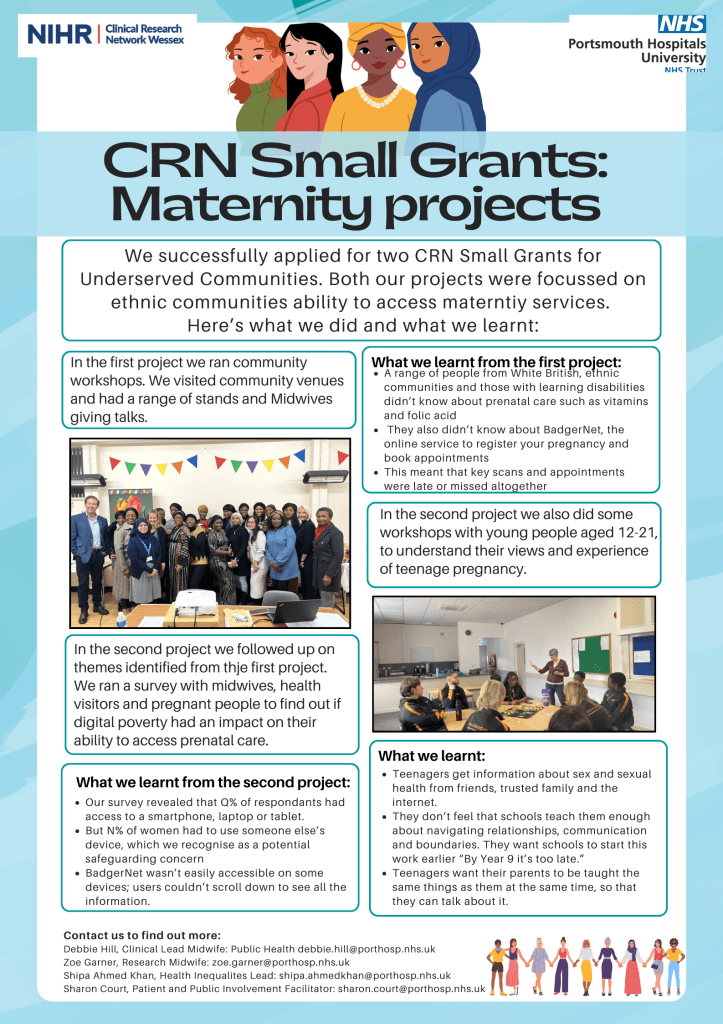
The Maternity project was a follow-on piece of work which had also been funded by CRN Wessex. In the first project we focussed on engaging with ethnic communities and people who may have had difficulty accessing maternity services. This piece of work, led by a fabulous midwife called Maf, revealed that not only women from ethnic communities, but also White British women, were having trouble navigating the digital Maternity services known as BadgerNet and Healthier Together, which were the only way in which they could register their pregnancy and book the essential maternity appointments and scans.
As a result of these findings, we applied again to CRN for a second small grant to explore whether digital poverty was the reason people were struggling to make their appointments and book scans. We also did another piece of work alongside this, looking at teenage pregnancy, to try and understand why the number of teen pregnancies were rising in our area.
Bianca spoke about her experience as a community researcher as part of the Sandbox project and Gail and I supported her by talking about how the project had come together and some of the things we’d learnt along the way. Later, I joined my colleagues Debbie and Zoe from the Maternity dept, to talk about the digital poverty survey they did, as well as explaining the outcomes of the workshops I’d run with young people in the area about attitudes and perceptions of sexual health, relationships and pregnancy.
Alongside us were a wealth of projects spanning people with learning disabilities, gambling addiction, dental care for refugees and asylum seekers, mental health and men and so many more! I was genuinely impressed by the rich depth of shared learning which these projects had brought forth, and throughout the presentations it was abundantly clear that they were linked by three main themes:
- all the projects were centered and designed around the people they wanted to work with
- all the projects were flexible and adapted to the needs of their participants
- the Small Grants scheme enabled people to try out something new, without the pressure and heavy admin involved in applying for a conventional research grant. This made it easier for the NHS and Universities to work with local partners to get something up and running without too much fuss or delay
I don’t know how many other CRNs across the country may also be running a Small Grants scheme, but the potential generated from the 39 projects which were supported over the last two years is just phenomenal. I would strongly advocate for funding processes which support this kind of work – particularly because they allow for such valuable person-centered working 😀



 Authentic PPIE - the (re)search for authentic engagement
Leave a comment