
Today was the final session in the Bournemouth University Masters level CPD Unit: Public Involvement in Research. Led by Professor Mel Hughes, Kate Jupp and two PIER members, Mandy and Julie, this course has been thoroughly engaging, well thought-out and a timely reminder that as much as you might think you know about a topic, there’s always more to learn!
I really enjoyed the fact that this module about public involvement was genuinely co-designed and co-delivered. There were some powerful and poignant moments when Julie and Mandy told their real-life stories and how they came to be involved with the PIER partnership. It reminded me again of the importance of valuing the person in front of you, and not making assumptions or judgements about the journey they’ve been on.
This course has been part of my ARC Wessex Research Internship: a six month mini-research project, allowing me to explore whether social pedagogy might be a good fit for PPIE. (If you want to find out a bit more about that, take a wander over here.)
This, alongside two courses I’ve been doing with ThemPra have given me space to do a deep-dive on a topic I’m quite familiar with, but have sometimes found it hard to describe to people who don’t do this role or work in this space. In a sense, I feel like I’m assembling, or perhaps reassembling the jigsaw pieces of my values, ethics and practice, into something which makes more sense to me and will hopefully therefore make more sense to others.
When I used to deliver sessions in schools, colleges and youth centres, I could tell when the young people I was working with really understood what I’d been trying to teach them: when they could explain things in their own words and when they could apply what they’d learnt to a practical or real-life situation.
Although I am a PPIE practitioner, I feel as if more pieces are being added to my jigsaw, so that the gaps inbetween are being filled in and the overall picture is gaining more clarity. If you can imagine a basic jigsaw of a cat, for example, but with a handful of pieces missing…even with bits missing, you recognise that it’s a cat from the bits you can see: a paw, a nose and whiskers, perhaps ears or a tail. But when all the pieces are added, you can see the depth and colour of its fur, the white socks on its feet and the deep green of its eyes.
This is how I feel about the training I’ve been on since the end of February – it’s bringing depth, clarity and focus. Of course, it’s also going to make my professional life harder, because I don’t want to go back to Piecemeal PPIE (TM) ! I want to develop a space and a culture where PPI2.0* (TM) can really begin to flourish. Whether I’ll get to do that remains to be seen, but the idea of going back to something less than that, kind of grates with me – but maybe that’s the point? The discomfort motivates you to make changes.
(*more on PPI2.0 in another post!)
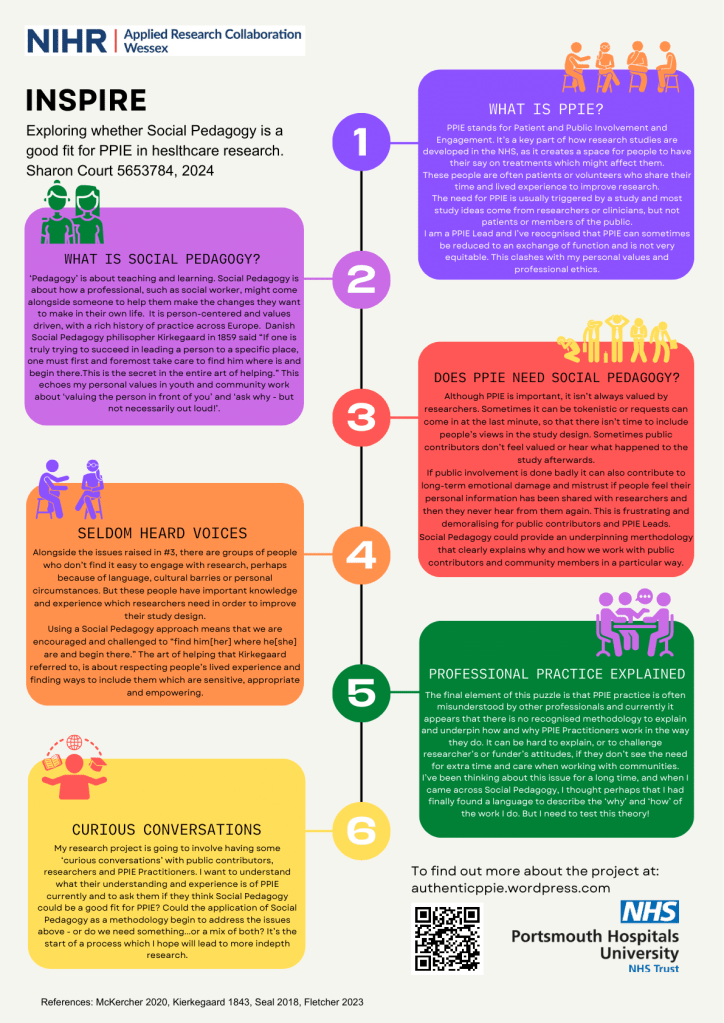
I’m going to put together a post on the highlights of the ThemPra course and what I’ve learnt over the last few months, in a later post. Meanwhile, if you’re interested, here’s a copy of the academic poster I created, outlining my project. It’s aimed at a wide audience and written intentionally to be (or at least try to be!) accessible to anyone. Do send back any comments or questions 🙂




 Authentic PPIE - the (re)search for authentic engagement
Leave a comment